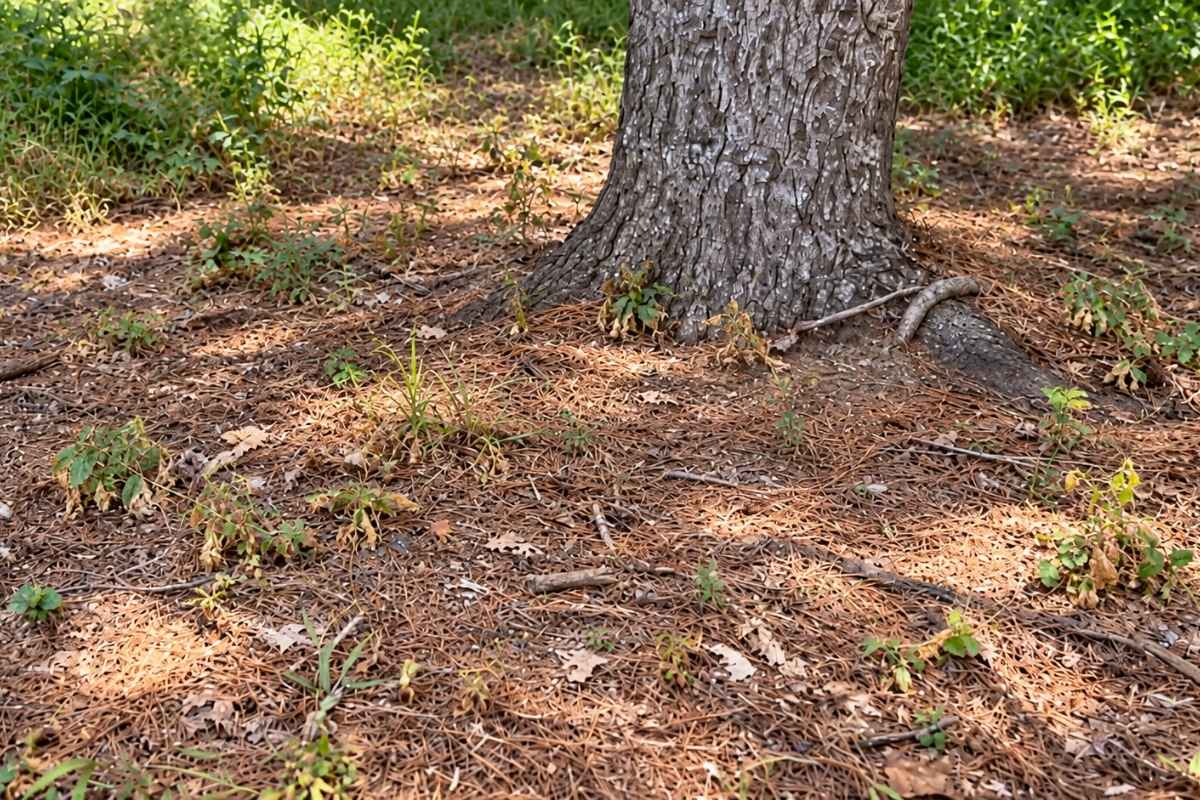
There’s something suspiciously convincing about the bare ground beneath a pine tree. Needles accumulate, grass disappears, and every hopeful little plant seems to give up by midsummer. Naturally, the needles get blamed. They’re acidic, after all. Case closed.
Except that explanation has a rather inconvenient problem.
Walk through a healthy pine forest, and you’ll often find ferns, woodland flowers, and other vegetation growing quite happily beneath conifers. Nobody is following them around with bags of lime.
So why does establishing ground cover under pine trees seem so difficult in an ordinary backyard?
Before you declare war on pine needles, it’s worth investigating what actually happens beneath the tree.
Yes, Pine Needles Are Acidic. No, That Isn’t the Whole Story.
Soil pH measures acidity and alkalinity on a scale where 7 is neutral. Lower numbers indicate acidity, while higher readings indicate alkalinity.
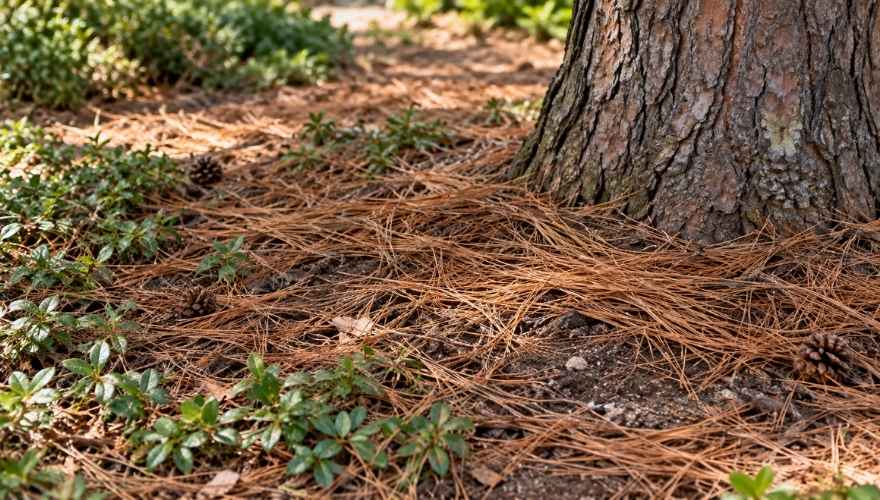
Fresh ponderosa pine needles can have a pH of approximately 3.2 to 3.8. That’s acidic enough to sound rather intimidating when you’re trying to grow delicate woodland plants nearby.
But measuring the acidity of a pine needle isn’t the same as measuring the soil beneath it.
Once needles fall, microorganisms begin breaking them down. Decomposition changes their chemistry, while natural soil-buffering processes limit their influence on surrounding soil.
Under ordinary conditions, accumulated pine needles generally don’t cause a meaningful, lasting reduction in soil pH.
Pine trees also frequently grow in naturally acidic soils. Finding acidic ground beneath one doesn’t establish that the tree caused it.
Many gardens there have naturally alkaline soils, yet pine trees grow successfully while dropping needles year after year.
If those needles were powerful soil acidifiers, you’d expect the accumulated litter to transform the soil. Instead, alkaline conditions frequently persist.
So much for the botanical conspiracy.
The Real Problem Is Happening Below Ground
A mature pine doesn’t need to poison its neighbors. It has already spent decades establishing an impressive underground advantage.
Pine Roots Have Already Claimed Much of the Available Water
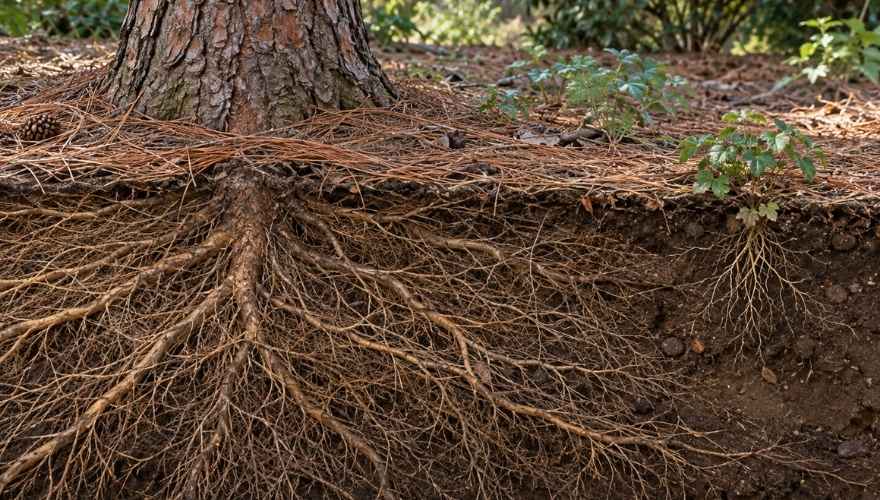
Established pine trees possess extensive networks of fine roots that absorb moisture and nutrients.
Many active roots occupy the upper soil layers, precisely where young ground-cover plants need to establish themselves.
Imagine planting a small perennial beneath a pine that’s been collecting water across the surrounding soil for forty years. Your new arrival has a root ball barely larger than a coffee mug.
Hardly a fair contest.
Competition becomes particularly intense during hot, dry weather. Pine roots are already using the moisture that smaller plants desperately need.
And here’s something worth remembering: shade tolerance and drought tolerance are two different abilities.
A plant might thrive beneath a shady porch where the soil stays consistently moist. Put that same plant beneath a thirsty pine, and suddenly its impressive shade tolerance isn’t much help.
Even species adapted to dry shade need dependable moisture while establishing.
The Canopy Makes a Dry Situation Even Drier
Pine branches intercept rainfall before it reaches the ground. Some water collects on needles and branches, then evaporates. Other droplets fall unevenly, leaving surprisingly different moisture conditions beneath the same tree.
After a decent rainstorm, soil near the trunk can still be dry several inches below the surface.
Persistent shade creates another complication. Limited sunlight restricts photosynthesis, slowing growth and reducing flowering even when plants survive.
Conditions often improve near the canopy’s outer edge, where additional light and rainfall may reach the ground. Finding suitable plants that grow under pine trees therefore involves more than checking a nursery label for the word “shade.”
You need plants capable of handling the particular combination of moisture, light, and root competition beneath your tree.
The Best Ground Covers Under Pine Trees Depend on Where You Live
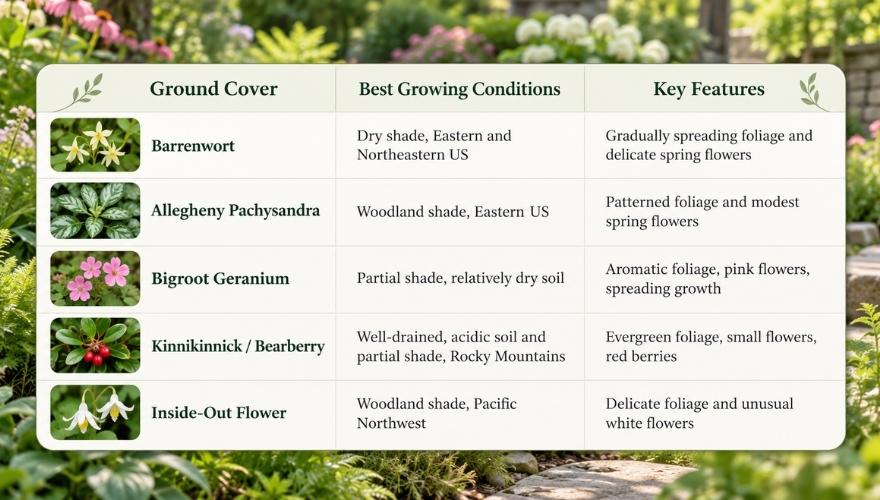
Searching for the best ground cover under pine trees often produces enthusiastic lists containing everything imaginable, including a few plants that would prefer considerably more water or sunshine.
Barrenwort (Epimedium spp.)
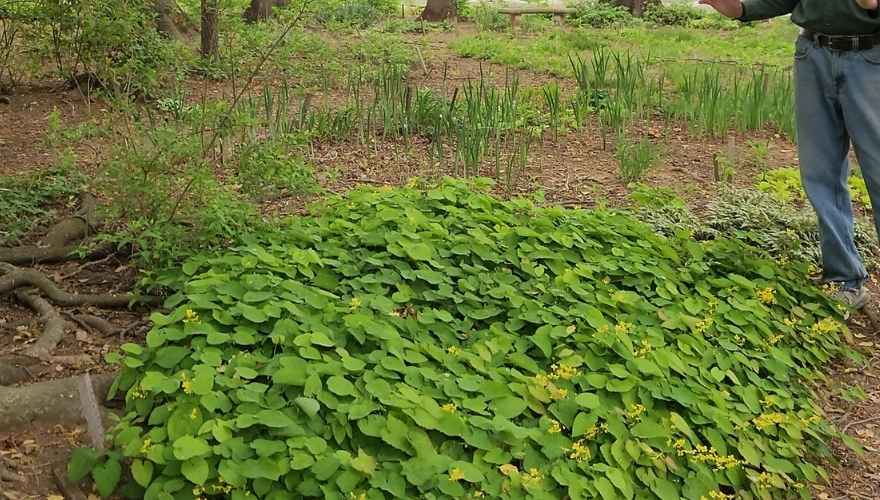
Barrenwort deserves serious consideration for established dry-shade gardens.
Its attractive foliage spreads gradually, while delicate spring flowers add interest without demanding center stage.
Many varieties tolerate root competition and relatively dry conditions once established.
Young plants still need regular moisture, though. Even a famously resilient perennial can’t develop an extensive root system overnight.
Allegheny Pachysandra (Pachysandra procumbens)
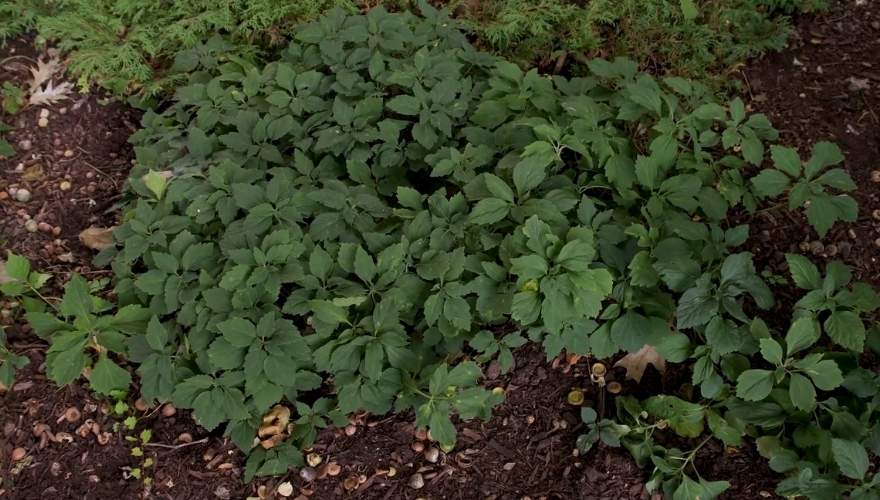
Native to eastern North America, Allegheny pachysandra makes an attractive option for shaded woodland settings.
Its patterned foliage and modest spring flowers give it a more natural woodland character than a conventional lawn replacement.
Established plants can tolerate some dryness, although extremely dry soil may require supplemental irrigation.
Bigroot Geranium (Geranium macrorrhizum)
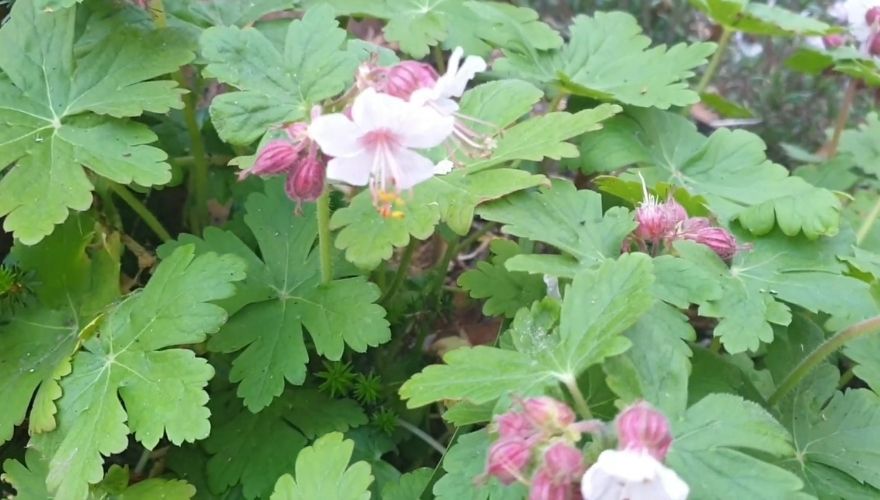
Bigroot geranium produces aromatic foliage, attractive pinkish flowers, and a spreading habit useful for covering open soil.
It tolerates relatively dry conditions and partial shade, making it a worthwhile candidate beneath pines with reasonably open canopies.
Very dense shade can reduce flowering and overall vigor.
Kinnikinnick or Bearberry (Arctostaphylos uva-ursi)
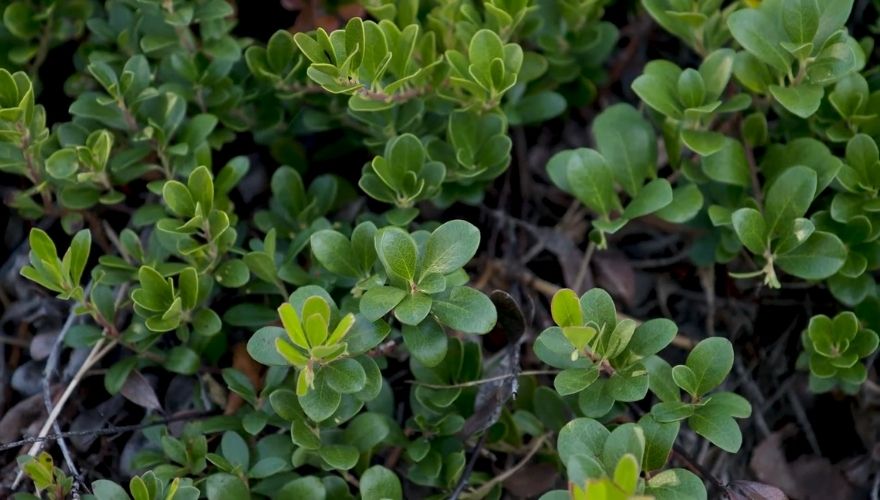
Bearberry is a low-growing evergreen with leathery leaves, small flowers, and red berries.
Its drought tolerance makes it interesting for well-drained sites receiving partial shade or filtered sunlight.
However, local conditions matter enormously.
Bearberry generally prefers acidic soil and may struggle in alkaline ground. Heavy shade can also limit its performance, particularly outside suitable mountain environments.
Even drought-tolerant species require supplemental watering during establishment.
For western gardeners investigating plants that grow under pine trees, bearberry is worth considering, but it’s certainly not a universal solution.
Inside-Out Flower (Vancouveria hexandra)
It grows naturally in shaded environments across parts of the Pacific Northwest, particularly west of the Cascades.
Established plants tolerate some seasonal dryness, but prolonged drought beneath dense pines can still cause trouble.
Conditions east of the Cascades are often considerably drier, so species adapted to local rainfall patterns may perform better.
Before Planting Anything, Find Out How Dry the Ground Really Is
Buying attractive woodland plants is considerably more exciting than investigating soil moisture.
Unfortunately, skipping that investigation can lead to an expensive collection of empty planting holes.
A Simple Moisture Check Can Save an Entire Planting
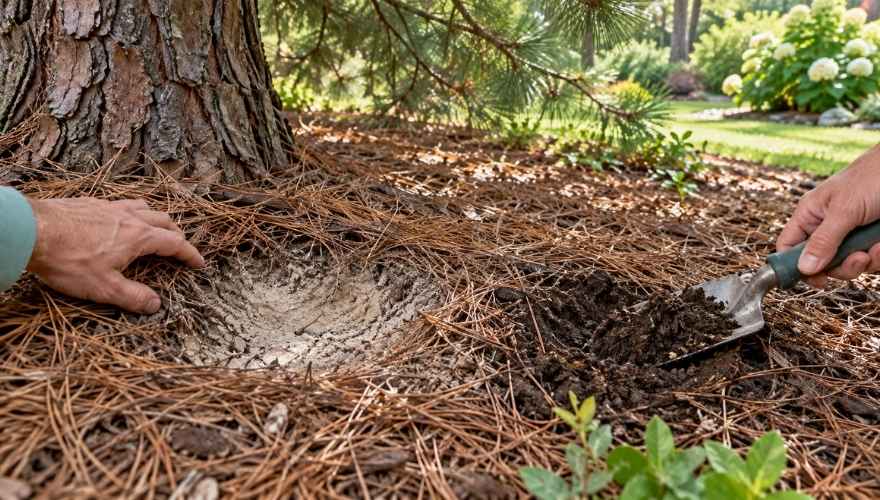
Move aside the loose pine needles and examine the soil several inches below the surface.
A hand trowel works perfectly well, although a soil-moisture probe can help identify differences across the planting area.
Check several locations, ideally a day after rainfall. You might discover that soil near the trunk feels almost powdery, while ground near the canopy’s edge is comfortably moist.
Those differences matter.
Know When Ground Cover Is an Unrealistic Goal
Occasionally, the soil tells you something you don’t particularly want to hear.
An area might have extremely dense roots, almost no sunlight, and very little accessible moisture.
Trying to establish living plants there can become a yearly exercise in optimism followed by disappointment.
Keeping a natural covering of pine needles beneath the most difficult portions of the tree is a perfectly reasonable alternative.
Not every square foot of a garden needs something growing in it.
Stop Fighting the Needles and Start Working With the Tree
Fresh pine needles are acidic, but ordinary needle litter generally doesn’t make surrounding soil too acidic for other plants.
Thirsty roots, intercepted rainfall, and insufficient sunlight are usually much more troublesome.
Successful ground cover under pine trees begins with investigating moisture and light, choosing appropriate species, protecting established roots, and providing adequate water while young plants establish.
And when a particularly difficult patch refuses to support vegetation, natural pine-needle mulch is a perfectly respectable solution.