Dry shade has a special talent for making perfectly sensible gardeners buy the same doomed plant twice. Picture the soil beneath a mature tree.
Branches cut down the sunlight, thick roots take an enthusiastic share of the available water, and smaller plants are left negotiating over the leftovers.
Many perennials respond by shrinking, sulking, and eventually disappearing. Also called barrenwort and bishop’s hat, epimedium looks suspiciously delicate for a plant with such stubborn habits.
Wiry stems carry little flowers that can resemble spiders, miniature orchids, or pointed hats. Heart-shaped leaves may open bronze or red before turning green. Certain epimedium varieties are also remarkably good at occupying those awkward shaded spots where previous planting plans have quietly gone to pieces.
Fairy wings above ground. Much tougher machinery underneath.
Why Epimedium Handles Dry Shade So Well
| Plant profile | Epimedium |
| Common names | Barrenwort, bishop’s hat, fairy wings |
| Plant type | Perennial |
| Foliage | Evergreen, semi-evergreen, or deciduous |
| Height | Usually 8 to 18 inches |
| Light | Part shade to full shade |
| Soil | Well-drained soil with moderate moisture |
| Flowering period | Early to mid-spring |
| Flower colors | Yellow, white, pink, orange, lavender, and red |
| Growth habit | Clumping or spreading by rhizomes |
| Maintenance | Cut old foliage in late winter or early spring |
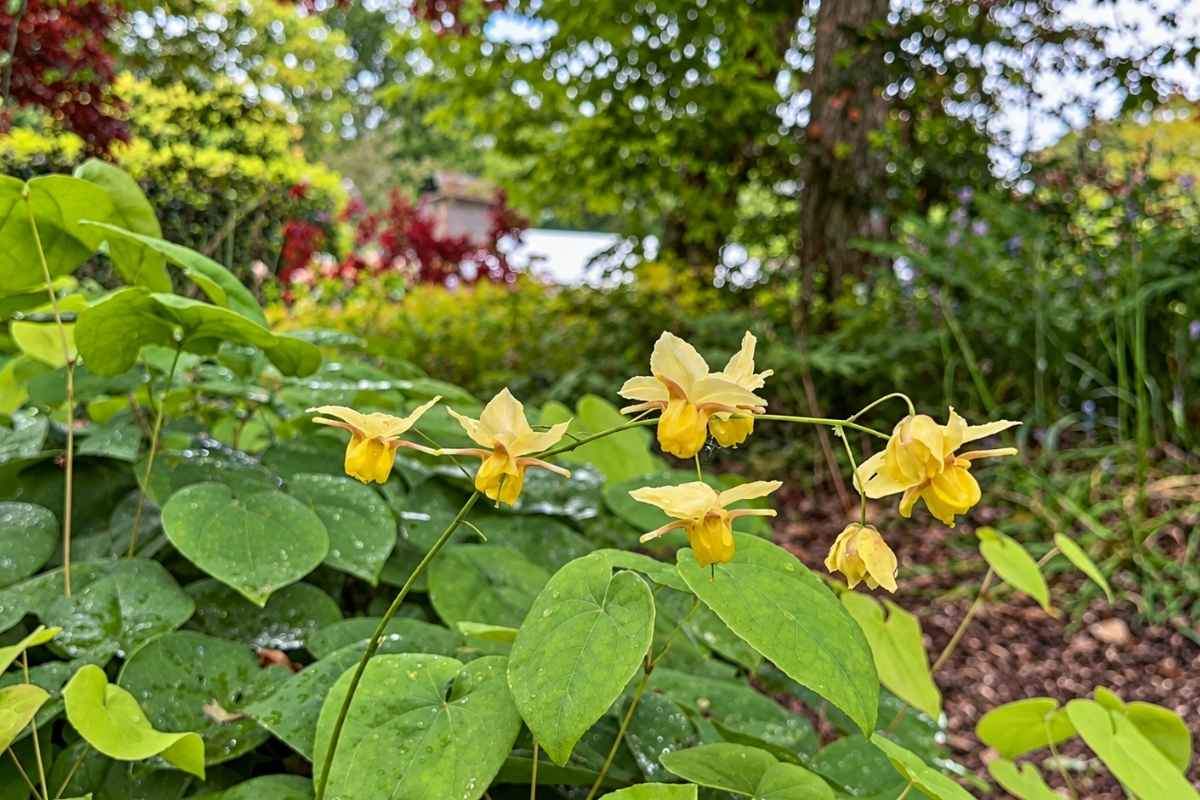
Epimedium × versicolor ‘Sulphureum’ is a classic example of the practical side of the genus. Plants usually reach about 12 inches tall and 18 inches wide.
Underground rhizomes gradually travel through the soil, allowing a mature patch to cover bare ground beneath trees and shrubs. Mid-spring brings airy, two-toned yellow flowers before fresh foliage has fully developed.
Heart-shaped leaves open with reddish coloring, mature to light green, and often turn reddish again in fall.
Part shade and full shade both suit it. USDA Zones 5 through 9 cover its usual growing range, while plants near the warmer end may behave more like evergreens. Good soil and moderate moisture produce happier plants, particularly during establishment. Older plants, though, can cope impressively well with dry periods.
Several other spreading forms have earned similar reputations. E. × rubrum, ‘Orangekönigin’, and ‘Frohnleiten’ are all known for relatively good drought tolerance.
Practicality explains why barrenwort so often gets its first invitation into a garden. Put it beneath an awkward tree, give it time, and those rhizomes can slowly occupy soil that defeated several prettier but thirstier candidates.
At some point, a gardener has to admit that buying another moisture-loving perennial will not intimidate the tree roots.
Tough Below Ground, Delicate Above
Nothing about an epimedium flower suggests underground determination. Blooms hang on fine stems and can resemble tiny orchids, spiders, or miniature hats.
That last comparison gave us the common name bishop’s hat, which is rather grand for a flower hovering six inches above leaf litter. Foliage is nearly as varied as the flowers.
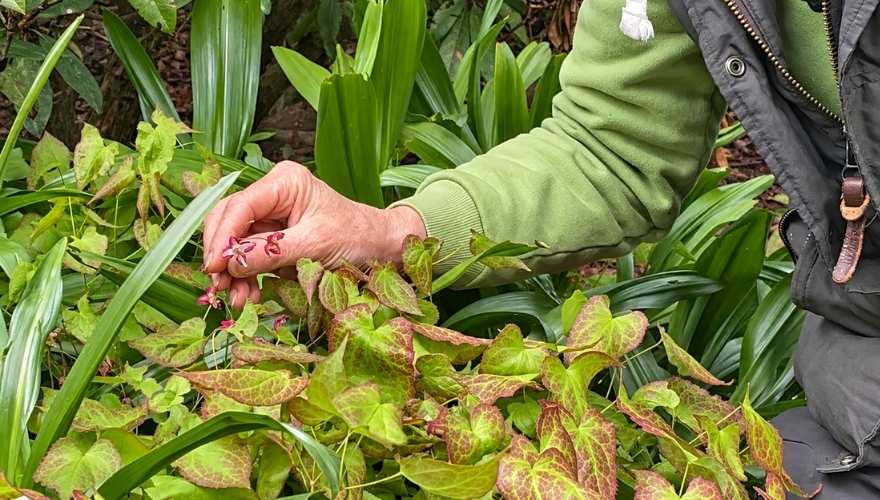
Familiar forms carry heart-shaped leaves, while certain Chinese species produce longer, arrow-shaped foliage with surprisingly fierce-looking edges. Fresh spring growth can become even more theatrical. Leaves may emerge bronze, red, speckled, mottled, or almost black.
Below all that delicacy sits a woody rhizome system. Epimedium grows through underground rhizomes, and their yearly growth largely determines how each plant behaves. Short extension produces compact clumps. Longer extension creates spreading colonies that slowly occupy more ground.
A clumping epimedium can sit politely beside neighboring perennials for years. A spreading type may decide that nearby soil looks available and proceed accordingly.
Not Every Epimedium Wants Dry Soil
Plant reputations become dangerous when shortened into slogans. Calling epimedium a dry-shade plant is useful, but incomplete.
Spreading groundcover types account for much of that reputation. Many clumping species prefer steadier moisture. Real gardens make the distinction obvious.
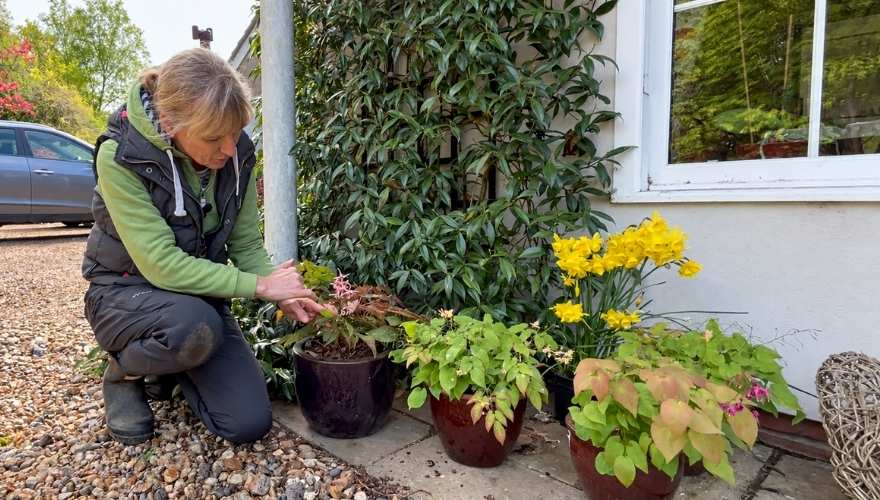
E. grandiflorum ‘Queen Esta’ can grow near thirsty trees, but extra watering may be needed during severe dry periods.
‘Orangekönigin’ has shown an ability to tolerate both moist and relatively dry soil. Even E. × rubrum, often described as fairly drought tolerant, will not automatically thrive in every dry garden. Soil structure, root competition, rainfall, and establishment all influence how well it performs.
E. wushanense also benefits greatly from well-drained soil and adequate moisture while settling in. Once established, it becomes noticeably tougher.
Interesting exceptions exist among clumping forms. ‘Lilac Cascade’ has a reputation for unusually good drought tolerance despite its clumping habit.
One rule is easier to remember than a shelf of plant labels. Treat “dry-shade tolerant” as a description of resilience, not permission to plant barrenwort in dust and walk away.
Young plants still need help building roots. Older plants may also flower and leaf out better with occasional watering during extended dry spells. Tough is useful. Magical would be asking too much.
Spring Is When Epimedium Shows Off
Dry-shade tolerance gets epimedium noticed. Spring makes people start looking for another one.
Flowers arrive early, often alongside spring bulbs, while much of a shaded garden is still deciding if winter has actually ended. Yellow, white, pink, orange, lavender, and red blooms appear depending on species and cultivar.
Fine stems lift them above emerging leaves, giving the flowers an almost suspended appearance. Fresh foliage can compete quite successfully for attention. Bronze, red, mottled, and nearly black new leaves occur on certain varieties. During a long, cool spring, flowers and colorful foliage can provide roughly six weeks of interest. Some types keep going.
E. grandiflorum can produce a second flush of leaves, extending the display into early summer.
Leaf shape can also hint at geographic origins. Japanese and Korean deciduous types often carry the familiar heart-shaped leaves associated with barrenwort. Chinese species frequently produce narrower, arrow-shaped foliage with more pronounced spiny margins.
Family relationships explain part of that prickliness. Epimedium belongs to the barberry family. Once you know that, some of those fierce little leaf edges stop looking quite so rebellious. Ferns, hostas, hellebores, and trilliums make particularly good companions because their leaf shapes contrast well with epimedium.
Treating every specimen as anonymous groundcover rather wastes half the entertainment.
Evergreen and Deciduous Epimedium Need Slightly Different Care
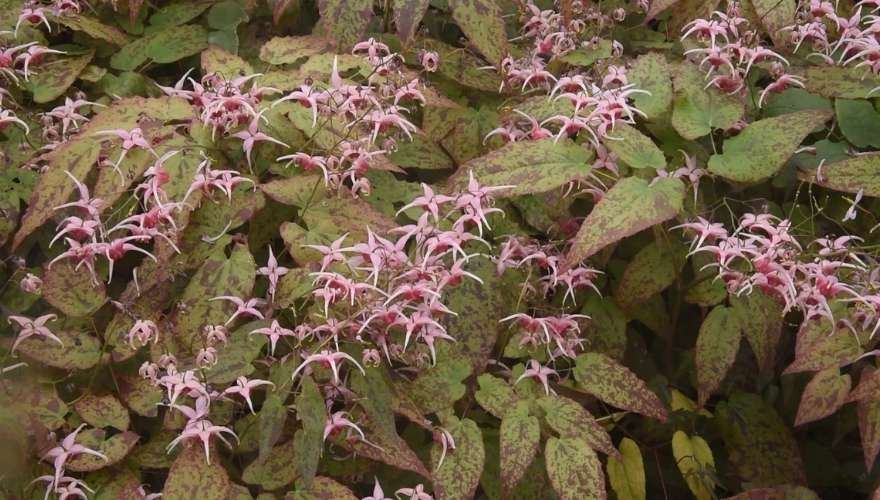
Maintenance is pleasantly uneventful, which feels almost suspicious after all the botanical excitement. Old foliage is the main job.
Cut tired leaves in late winter or very early spring so incoming flowers can be seen clearly. Timing matters because epimedium flower stems can appear quickly, and chopping through fresh shoots while enthusiastically tidying last year’s leaves is an impressively efficient way to ruin your own spring display.
Many gardeners wait until new flower stems and leaves just begin to appear. Old foliage can then be removed carefully around the fresh growth.
Deciduous epimedium can also be tidied in fall after leaves die back. Evergreen and semi-evergreen types are usually better left alone through winter, then trimmed before spring growth develops. Older leaves can offer some winter structure and help protect the crown.
Miss the ideal pruning window? No catastrophe follows. Fresh leaves and flower stems can usually push through last year’s foliage. Everything simply looks a little untidier.
Large colonies of spreading barrenwort allow a much less delicate approach. Some gardeners mow mature patches before new growth starts.
Consider that for a moment. A perennial called fairy wings can carry orchid-like flowers, inspire plant collectors, and occasionally receive lawnmower maintenance.
Closing Thoughts
Very few gardeners wake up one morning consumed by a desire to study members of the barberry family. Usually, something has died under a tree.
Grass refuses to cooperate. Hostas struggle in dry soil. Another shade perennial slowly gives up. Bare ground keeps winning.
Barrenwort arrives as the sensible candidate. Then spring happens. Yellow flowers hover on wiry stems.
Copper-colored leaves push through last year’s foliage. Another variety turns out to have mottled leaves. Someone mentions a Chinese species with long, spiny foliage.