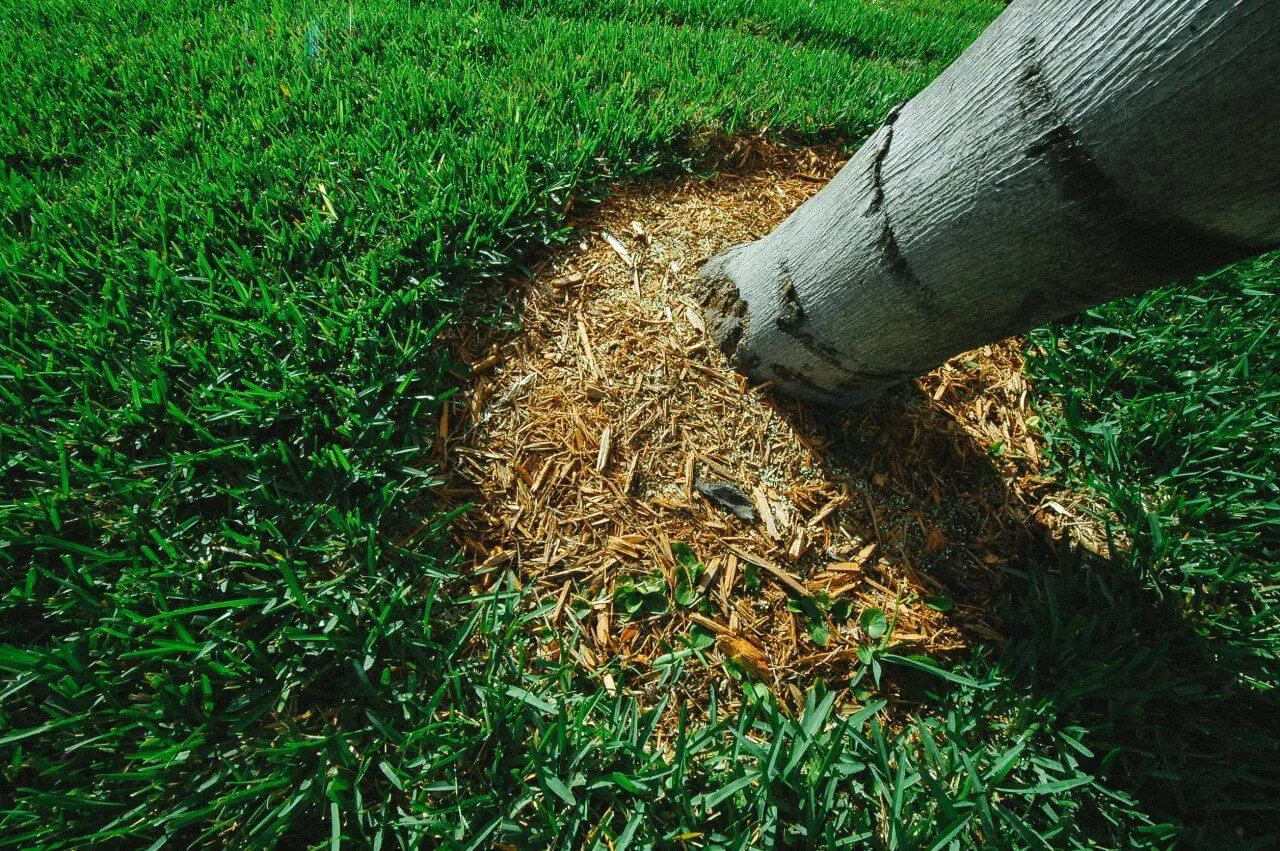
A mature tree can be the pride of a garden, right up until you look at what is happening underneath it.
Grass struggles, perennial plants sulk, and the soil often feels suspiciously dry even after a decent rain. Meanwhile, the tree overhead looks perfectly happy with the arrangement.
Much of that trouble comes down to competition. A thick canopy intercepts rainfall, while an extensive network of roots takes up water before smaller plants get much of a chance.
Adding mulch under trees can help conserve moisture, protect shallow roots, and gradually improve soil conditions. Done badly, however, mulching can trap moisture against the trunk, restrict airflow, and create entirely new problems.
So, which materials genuinely help dry shade soil, and which gardening habits are making an already difficult patch even worse?
Why Soil Under Trees Stays So Dry
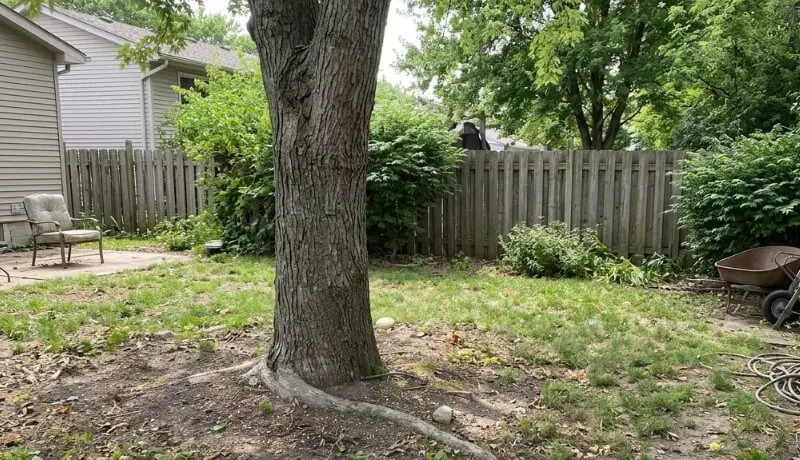
Shade might seem like an excellent way to keep soil moist. Unfortunately, mature trees have other ideas.
Large canopies intercept rainfall, particularly during lighter showers. Water that reaches the ground then encounters an established root system already equipped to collect it.
Root competition extends considerably farther than most gardeners realize.
Large tree root systems can spread two to three times past the canopy’s outer edge. Consequently, plants growing outside the obvious shaded area may still compete with the tree for moisture and nutrients.
Much of that activity also happens surprisingly close to the surface.
Many tree roots occupy the upper 6 to 12 inches of soil, precisely where grass, young perennials, and shallow-rooted groundcovers try to establish themselves.
Bare soil adds another difficulty. Exposed ground loses moisture through evaporation, while repeated foot traffic can compress the soil and reduce the air spaces that roots need.
Even a healthy tree cannot make compacted ground particularly welcoming for its smaller neighbors.
Mulch helps address several of these problems, although it cannot persuade a mature oak or maple to stop drinking.
What Mulch Actually Does for Dry Shade Soil
Walk through an established woodland and look at the ground.
Bare soil is surprisingly uncommon. Fallen leaves, twigs, bark fragments, and decaying wood create a protective covering that gradually breaks down.
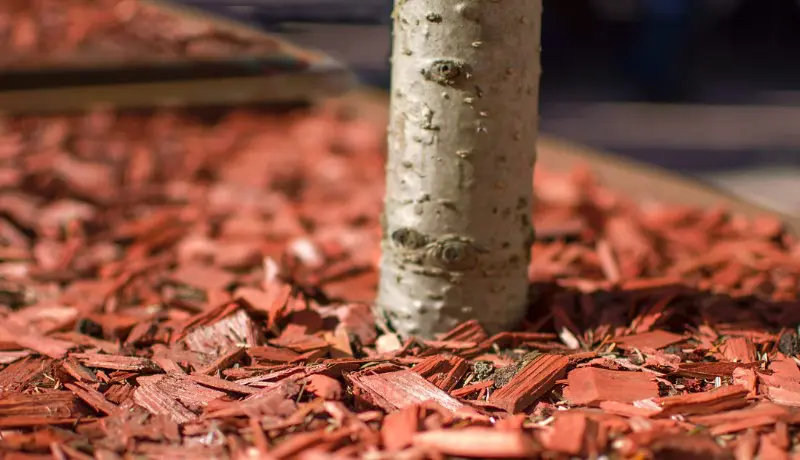
Applying mulch under trees recreates some of those woodland conditions, giving exposed soil a protective covering without disturbing established roots.
A properly maintained organic mulch layer offers several benefits:
| Benefit | How Mulch Works | Practical Effect |
| Moisture conservation | Reduces soil evaporation | Keeps moisture available longer |
| Temperature regulation | Insulates the soil surface | Protects shallow roots against heat |
| Soil improvement | Decomposes into organic matter | Adds nutrients and supports soil life |
| Reduced competition | Blocks sunlight reaching weeds | Reduces competition for water and nutrients |
| Less soil compaction | Cushions rainfall and foot traffic | Helps preserve soil structure |
Another benefit often goes unnoticed.
Mulch creates a physical boundary between the tree and lawn maintenance equipment.
String trimmers and mower blades can injure bark, so replacing struggling grass with mulch also helps keep those machines away.
One important distinction deserves attention, though.
Mulch conserves water already present in the soil. It does not create additional water.
During prolonged drought, supplemental irrigation may still be necessary, especially when smaller plants are trying to establish beneath an established tree.
The Best Mulch Materials for Under Trees
Different organic materials provide different benefits, and choosing the right one matters more than finding the most decorative bag at the garden center.
Wood Chips and Shredded Bark
Coarse wood chips and shredded bark are among the most practical options for mulching beneath mature trees.
Their relatively open structure allows air and water to move through the covering. They also suppress weeds, reduce surface evaporation, and break down gradually.
Wood chips are especially useful for broad mulched areas where frequent replacement would become tiresome.
Occasionally, gardeners worry that fresh wood chips will steal nitrogen and leave nearby plants struggling.
Some nitrogen immobilization can occur where microorganisms decompose woody material in direct contact with soil.
However, wood chips spread over the surface generally pose much less nitrogen competition than fresh wood mixed directly into the planting soil.
Yard and Garden
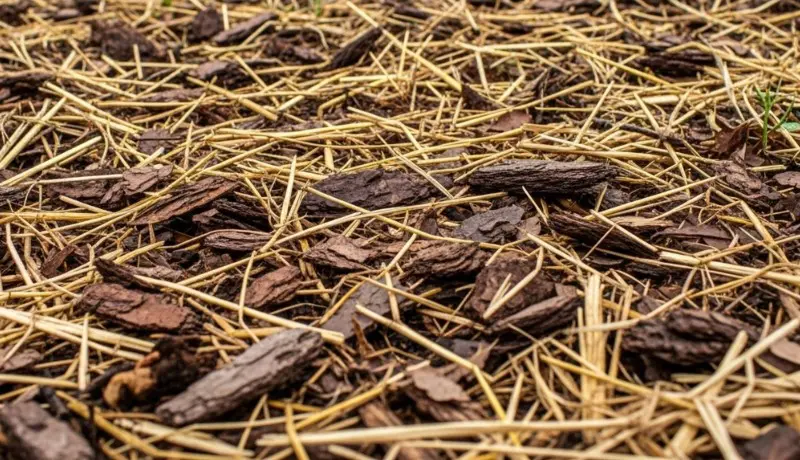
Keeping woody mulch on top, rather than digging it into the root zone, is usually the more sensible approach.
Shredded Leaves and Pine Needles
Fallen leaves are a perfectly respectable mulch material. Trees have been producing their own supply for rather longer than garden centers have existed.
Shredded leaves gradually decompose, contributing organic matter and helping protect surface soil.
Whole leaves can also work, although thick layers of small, flat leaves sometimes mat together when wet. Shredding them or mixing them with coarser material reduces that risk.
Pine needles provide another lightweight option, particularly around established woodland plants.
Despite their reputation, pine needles do not automatically turn garden soil excessively acidic. Their effect on soil pH is generally modest, especially when used as a surface covering.
What About Compost?
Compost offers something slightly different.
Its fine texture and relatively advanced decomposition make it useful for improving organic matter and supplying nutrients. However, it generally breaks down faster than coarse wood chips.
For an established planting area, a light compost top-dressing beneath a layer of wood chips can provide both soil improvement and longer-lasting protection.
When replanting beneath trees, 1 to 2 inches of compost or suitable topsoil may help prepare planting pockets, provided existing roots are disturbed as little as possible.
Avoid spreading substantial quantities of new soil across the entire root zone.
Existing tree roots need oxygen, and burying them under additional soil can interfere with that supply.
Mulching Mistakes That Can Make Things Worse
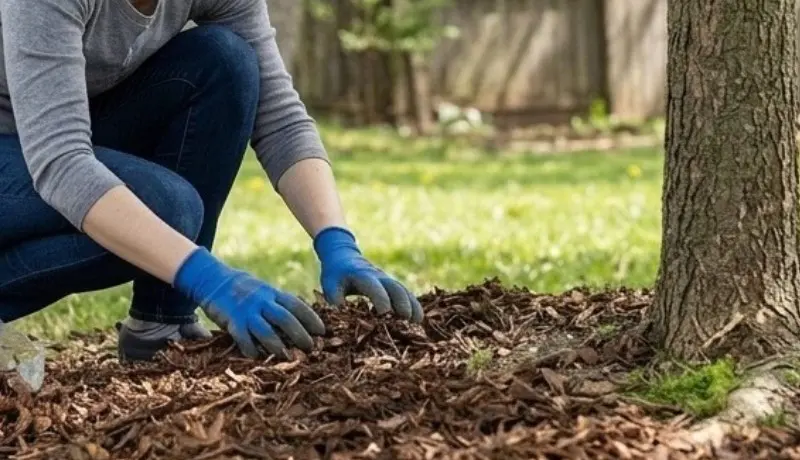
Mulch is helpful, but application matters enormously.
A protective covering can become a problem when it is piled too high, packed too tightly, or placed against parts of a tree that were never supposed to be buried.
The Infamous Mulch Volcano
Anyone who has walked past freshly landscaped parking lots has probably encountered one.
A tree trunk rises out of an impressive cone of shredded bark, sometimes resembling a miniature volcanic mountain.
It looks deliberate. Unfortunately, trees are not particularly impressed.
Mulch piled against the trunk keeps bark persistently damp, encouraging decay and creating favorable conditions for certain insects and diseases.
Buried root flares are another concern. A root flare is the widened area where the trunk transitions into the main roots.
Healthy tree care generally involves keeping that area visible rather than covering it with mulch.
A flat, broad mulch ring with an open center is far preferable to a cone wrapped around the trunk.
Too Much Mulch in the Wrong Place
@jplandscapedesign Watch as I explain why piling too much mulch around the tree can slowly kill it. #lawncare #landscaping #smallbusiness #treecare #arboriculture ♬ original sound – jplandscapedesignltd
Mulch depth deserves more attention than it usually receives.
Utah State University’s forestry guidance recommends approximately 4 to 6 inches of coarse organic mulch, while cautioning against equally thick layers of finer material that may mat together.
Other university extension recommendations are more conservative, commonly advising 1 to 2 inches for routine tree mulching. Material texture, drainage, and existing mulch depth all influence the appropriate amount.
Interestingly, research published in 1991 examined what happened beneath a much thicker covering.
Gary Watson and Gary Kupkowski tested an extraordinary 18-inch layer of wood chips over soil containing tree roots.
After two years, researchers found no detrimental differences in measured soil temperature, moisture, oxygen diffusion, or root density compared with unmulched soil. Additional roots had even grown into the mulch itself.
However, the experiment did not establish that burying a tree trunk beneath 18 inches of mulch is safe.
For ordinary gardens, moderate depth and generous horizontal coverage are much more useful goals.
Plastic Sheets and Decorative Gravel
Plastic sheeting might sound like an efficient solution to persistent weeds.
Unfortunately, impermeable plastic can interfere with water movement and restrict the oxygen available to tree roots.
Decorative gravel, marble chips, and similar materials introduce another limitation.
Although stone can cover bare soil, it adds no organic matter and cannot improve soil structure through decomposition.
Some stone coverings also absorb substantial heat, making them less suitable around shallow-rooted trees during hot weather.
A tidy surface is not necessarily a healthy one.
Will Mulch Make Dry Shade Suitable for Plants?
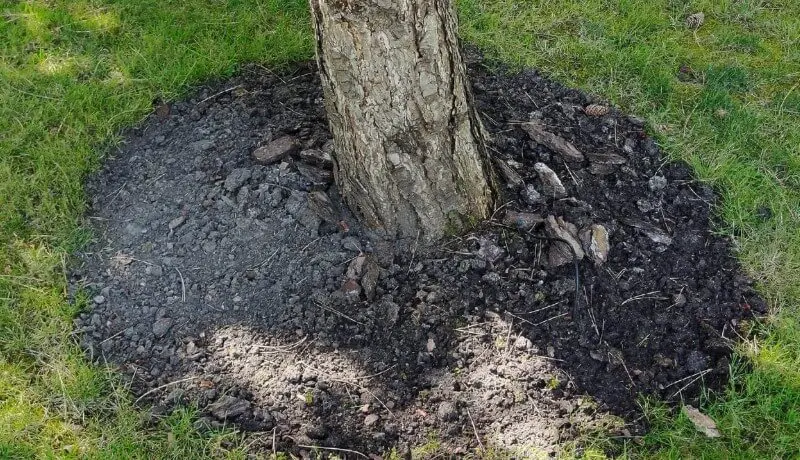
Mulching can make dry shade soil more hospitable, but it cannot eliminate competition beneath a mature tree.
Even familiar shade-loving plants, including astilbes, azaleas, and certain ferns, may struggle when moisture is scarce and tree roots dominate the planting area.
Some species are better equipped for these conditions.
Potential candidates include:
- Barrenwort – A resilient groundcover that can tolerate established dry shade once settled.
- Hardy ginger – Useful for sheltered woodland conditions, particularly where some soil moisture is available.
- Hellebores – Long-lived perennials that tolerate partial shade and periods of dryness after establishment.
- Christmas fern – A North American evergreen fern suited to shaded woodland sites, although it still needs adequate moisture while establishing.
Plant selection should account for local climate, drainage, soil conditions, and the particular tree overhead.
New plants also need time.
Consistent moisture during the first one or two growing years can be especially important, even for species described as drought-tolerant.
Hot, dry spells may require weekly thorough watering, with frequency adjusted to actual soil moisture rather than a fixed schedule.
Planting in small gaps between established roots is safer than excavating an entire bed and damaging the tree’s existing root system.
Still, sometimes the best gardening decision is to stop planting.
Under an exceptionally competitive tree, a broad mulch-only bed may protect the root zone, suppress weeds, and look considerably better than another collection of struggling perennials.
Not every patch of soil needs to become a flower bed.
Work With the Tree, Not Against It
A mature tree has spent years developing an extensive root system, collecting available moisture, and adapting to its particular patch of ground.
Expecting a few young perennials to compete successfully without assistance is asking rather a lot.
Using coarse organic mulch under trees offers a practical way to improve soil conditions without disturbing established roots. Generous coverage, sensible depth, and an exposed root flare matter far more than decorative perfection.
Adding water when necessary, choosing appropriate plants, and resisting the temptation to bury troublesome roots under fresh soil can make an equally important difference.
Sometimes gardening beneath trees is simply about recognizing that the biggest plant in the garden has already claimed the best seat.