
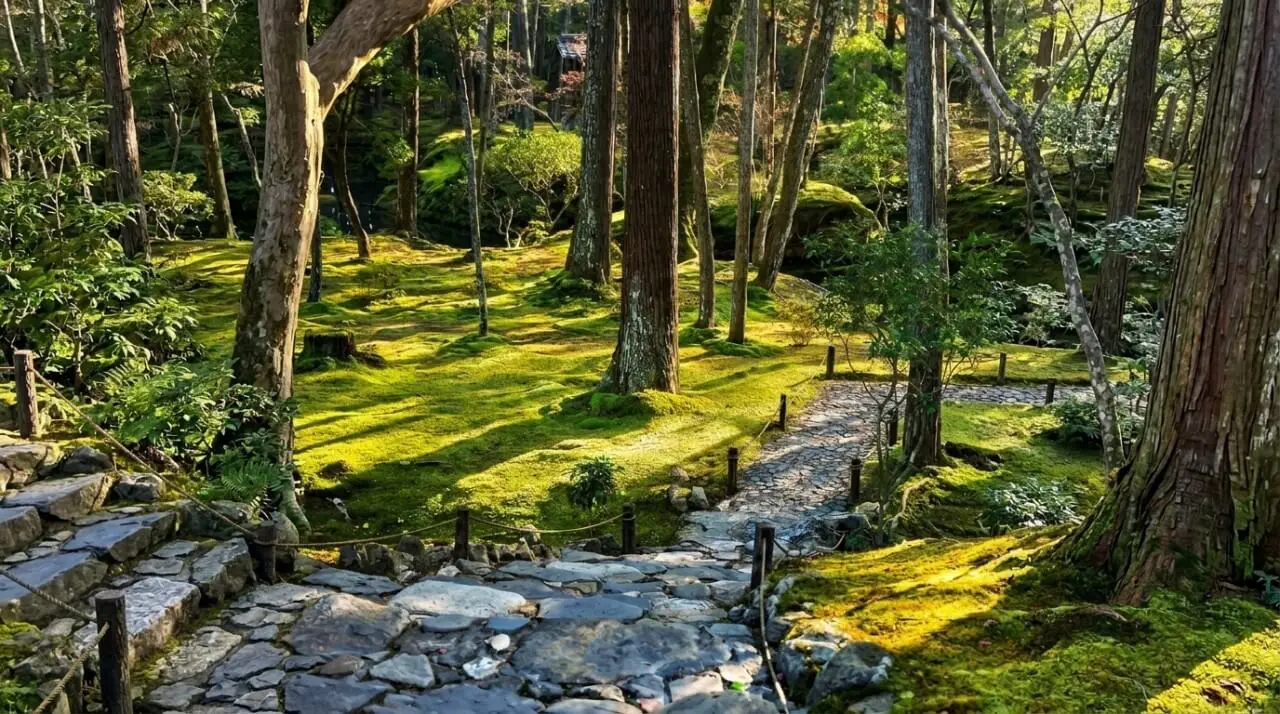
Most gardeners consider moss an unwelcome guest. It creeps across lawns, settles between paving stones, and generally ignores every attempt to make it leave. Yet in Kyoto, Japan, an ancient Buddhist temple has turned that very same plant into its greatest attraction.
Welcome to Saihō-ji, better known as Kokedera, or the Moss Temple, where more than 120 varieties of moss cover the shaded grounds beneath towering trees.
Soft green carpets surround winding paths, climb over stones, and stretch toward a peaceful pond. Even tree roots appear to have acquired their own velvety upholstery.
Few gardens make such an ordinary plant look quite so extraordinary.
Perhaps the strangest detail, however, is that nobody originally planned for Saihō-ji to look like this. Its famous green covering arrived gradually, helped along by centuries of neglect, flooding, and favorable growing conditions.
Apparently, nature had a few decorating ideas of its own.
From Zen Garden to Moss-Covered Masterpiece
View this post on Instagram
Saihō-ji’s story begins long before its moss became famous. Traditionally founded in 731, the temple initially belonged to the Hossō school of Buddhism during Japan’s Nara period (710-794).
Its most influential transformation came in 1339, when the celebrated Zen monk and garden designer Musō Soseki restored the neglected property and established it as a Rinzai Zen temple.
Soseki was no ordinary gardener. His designs helped shape Japanese garden traditions, influencing prominent sites associated with Kyoto’s Golden and Silver Pavilions.
Interestingly, his original vision looked considerably different.
Instead of endless green carpets, the grounds featured white sand, carefully positioned rocks, pine trees, and seasonal cherry blossoms. Water played an equally important role, with a central pond and strategically arranged islands creating carefully considered views.
Soseki organized the garden into two distinct levels. Its lower section centered on the spring-fed Golden Pond, while an upper hillside contained a karesansui, a traditional Japanese dry garden using stones and gravel to suggest natural scenery.
Unfortunately, medieval Japan wasn’t particularly accommodating to delicate garden maintenance.
During the Ōnin War (1467-1477), which devastated much of Kyoto, Saihō-ji suffered extensive damage. Its buildings burned in 1469, while subsequent floods during the 17th century caused further destruction.
As the property deteriorated, moisture-loving moss gradually established itself.
By the later Edo period (1603-1868), moss had become increasingly prominent, eventually covering much of the garden’s lower level.
Exactly how the transformation occurred isn’t entirely certain. One theory suggests that repeated flooding prompted workers to dredge the pond, depositing wet sediment on its islands. Such conditions would have encouraged moss to spread.
Over time, a garden originally associated with white sand and carefully arranged vegetation acquired an entirely different appearance.
Curiously, much of Soseki’s underlying design survived, including the pond’s shape, island positions, and stone arrangements.
Nature hadn’t erased his work. It had simply added several centuries of green.
More Than 120 Varieties of Moss – A Surprisingly Green World
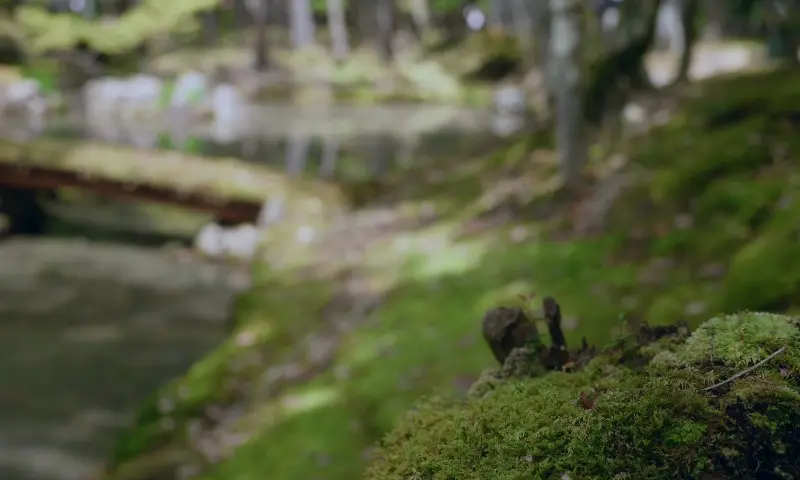
At first glance, Saihō-ji might look like one enormous moss carpet. Look more carefully, however, and the differences become apparent.
Some patches form rounded, cushion-like mounds, while others spread into low, tightly packed mats. Certain varieties resemble miniature ferns, with delicate branches producing feathery textures. Others create thick, velvety coverings across the soil.
According to the Japan Tourism Agency’s description of Saihō-ji’s gardens, more than 120 kinds of moss grow across the temple grounds.
Such variety is particularly impressive considering how easily moss gets dismissed as a single, rather uninteresting plant.
Why Does Moss Grow So Well Here?
Moss has a rather different approach to survival compared with flowering plants.
Most mosses lack true roots and the internal plumbing that allows trees and many other plants to transport water efficiently. Instead, they absorb moisture directly across their surfaces and use tiny rootlike structures called rhizoids primarily for attachment.
Consequently, humidity and access to moisture play particularly important roles in their growth.
Saihō-ji offers an excellent combination of favorable conditions.
Tall trees provide substantial shade, helping protect the moss against excessive sunlight and drying. Nearby hills shelter the grounds, while springs, rainfall, and the central pond contribute to a consistently moist setting.
Naturally, different moss species have different tolerances. Some survive periods of drying, while others depend on persistently damp conditions.
Such small environmental differences help explain how such a wide variety can occupy the same garden.
A Garden That Changes With the Seasons
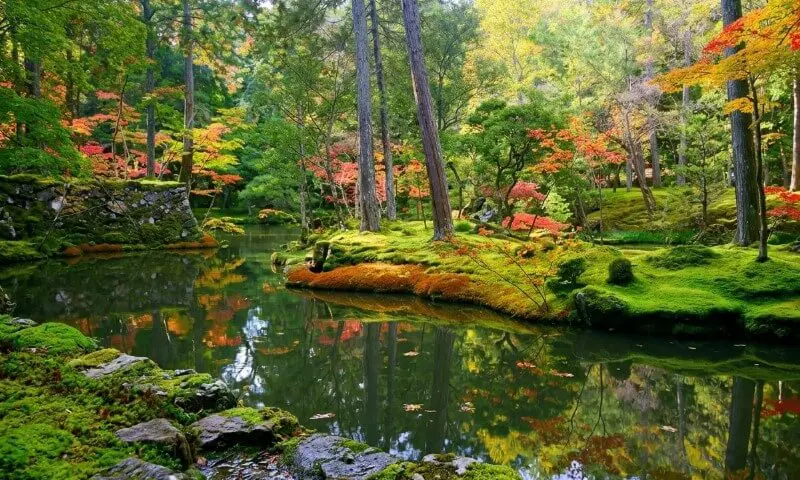
Kyoto’s rainy season, generally occurring during June and July, is particularly rewarding for moss enthusiasts.
Frequent rainfall saturates the ground, allowing moss to absorb moisture and display its vivid green coloring. Surfaces that might appear muted during drier periods become noticeably brighter.
Meanwhile, water droplets collect among delicate leaves, giving certain patches a slightly glossy appearance.
Autumn produces another striking contrast.
As maple leaves turn orange, crimson, and gold, their colors appear especially vivid against the green covering beneath them. Fallen leaves introduce temporary patterns across the garden floor, creating an entirely different scene.
Even winter has its own character, with subdued tones and occasional frost altering the appearance of the moss.
An Unexpected Lesson in Moss Conservation
Keeping Saihō-ji beautiful requires considerably more thought than simply allowing nature to do whatever it likes.
One particularly interesting example concerns fallen leaves.
Ordinarily, gardeners remove leaf litter to prevent moss from being deprived of light. At Saihō-ji, however, caretakers sometimes deliberately leave leaves in place during winter.
Why?
Cold weather can dry the moss, and fallen leaves help retain moisture. Excessive sweeping also risks damaging delicate growth, especially when frost forms beneath the surface.
During particularly cold periods, foot traffic can break frozen moss structures, making restricted access an important part of its protection.
Rain presents another maintenance problem. Wet leaves cling stubbornly to moss, and attempting to remove them with force can damage the plants underneath.
Consequently, caretakers may postpone sweeping and concentrate on maintaining pathways or preparing equipment instead.
Such details reveal something easily overlooked. Saihō-ji’s moss may have spread naturally, but preserving its appearance now requires careful human intervention.
Rather than forcing the garden into perfect obedience, its caretakers adapt their work to seasonal conditions.
Why Visiting the Moss Temple Is No Ordinary Garden Stroll
Anyone expecting to wander into Saihō-ji whenever the mood strikes may be disappointed.
Unlike many popular sightseeing attractions in Kyoto, Kokedera operates as an active Zen Buddhist temple, with visitor access carefully controlled.
Its unusual visiting arrangements have an interesting history.
Saihō-ji first opened its garden to the public in 1928. Following World War II, public enthusiasm for Japanese gardens increased considerably, bringing growing numbers of visitors to the temple.
By the mid-20th century, crowds had become a serious problem.
Congestion, litter, traffic, and noise increasingly threatened the peaceful atmosphere. At one point, Saihō-ji reportedly attracted the fourth-highest visitor numbers among Kyoto’s temples.
In 1977, temple authorities introduced a reservation system, restricting admission rather than continuing to accommodate ever-larger crowds.
Such a decision was particularly significant during a period when popular attractions increasingly depended on tourism.
A UNESCO Garden With Carefully Protected Grounds
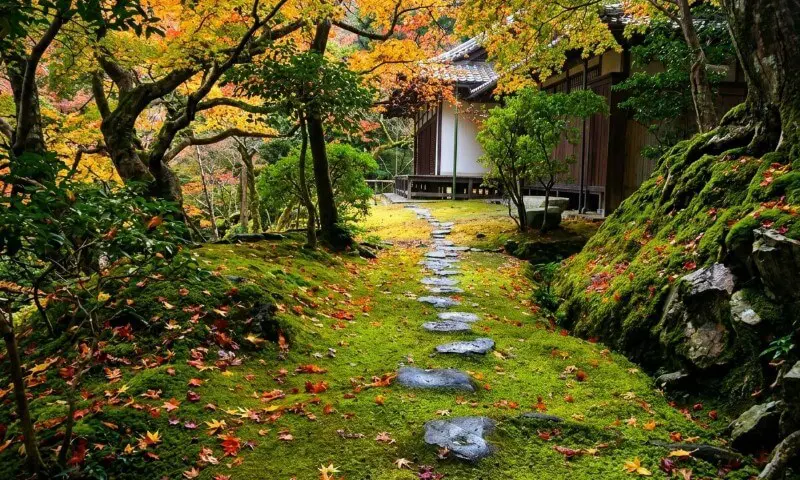
Saihō-ji gained additional international recognition in 1994, when it became part of the UNESCO World Heritage listing for the Historic Monuments of Ancient Kyoto.
Its importance extends well past the spectacular moss.
Soseki’s original garden design helped influence later Japanese garden architecture, particularly the relationship between buildings, water, stones, and carefully selected viewpoints.
Golden Pond offers a particularly interesting example.
Its outline resembles the Japanese character kokoro, associated with the heart or mind. Three islands within the water bear names translated as Sunrise, Sunset, and Mist.
An upper rock garden adds another dimension, showing how much of the original Zen design survives beneath the site’s leafy appearance.
Visitors can experience these features while following designated paths, which help protect the fragile moss from repeated trampling.
Rainy-season greenery and autumn foliage are especially attractive, although each season offers a different atmosphere.
Advance reservations are essential, and arrangements can change. Anyone planning a visit should consult the official Saihō-ji reservation system for current admission requirements and availability.
When Nature Improves on the Original Plan
Musō Soseki probably wouldn’t recognize every detail of the garden he designed in 1339.
Its rocks and ponds still preserve his intentions, but centuries of rain, flooding, shade, and gradual botanical colonization have produced an appearance he could scarcely have anticipated.
Yet Saihō-ji’s story isn’t simply one of nature overpowering human design.
Careful maintenance now protects the very growth that originally appeared without invitation. Monks, gardeners, and visitors all play a part in preserving a place shaped equally by deliberate planning and unpredictable environmental change.
More than 120 varieties of moss certainly make an impressive botanical collection. Still, the fascinating part is how an ordinary plant became the defining feature of one of Japan’s most celebrated gardens.
At Saihō-ji, moss didn’t merely creep into the garden. Given a few centuries, it became the main attraction. If you have a dry, shady patch of your own, these plants for dry shade are an easier start than a few centuries of patience.