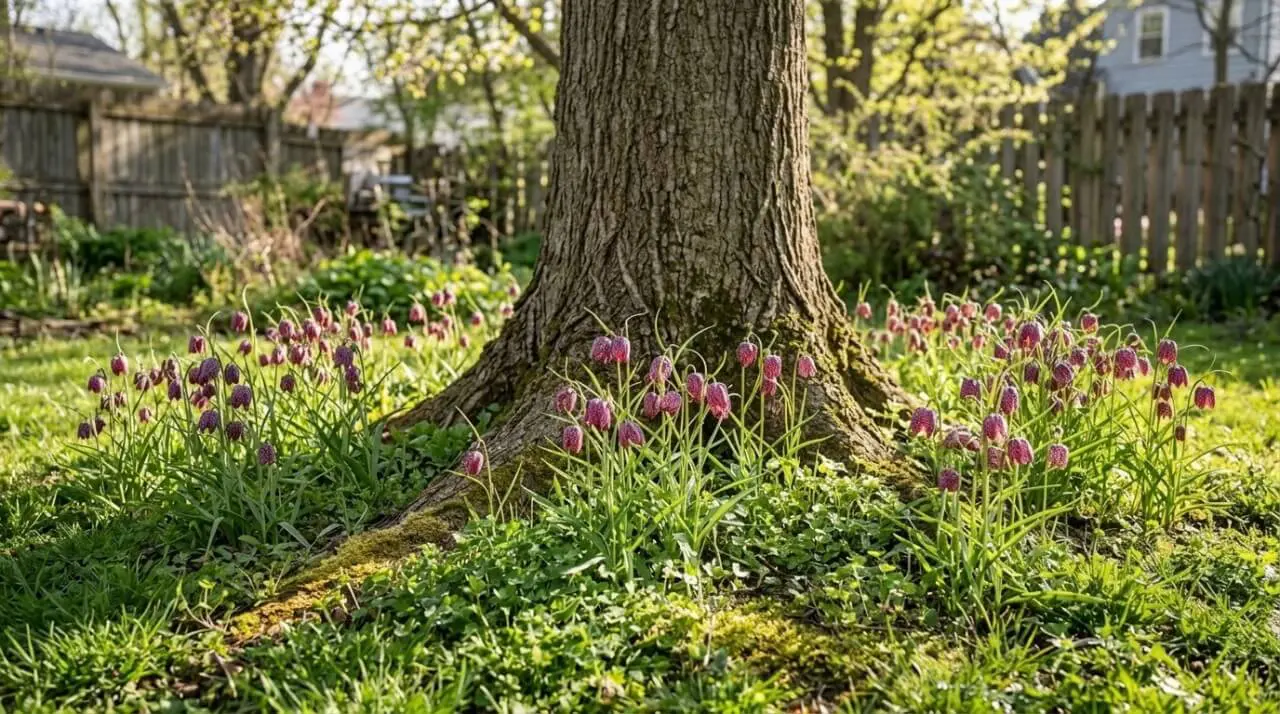
Anyone who has tried gardening beneath a mature tree knows the peculiar frustration of finding a perfectly good patch of soil that apparently refuses to grow anything.
Dig a few inches down, and you’re likely to meet a tangle of roots. Look up, and there’s an enormous canopy waiting to steal the sunlight. Add soil that dries out almost as soon as it rains, and even the weeds seem reluctant to settle in.
Anyone wondering why nothing grows under a big tree will discover that shade is only part of the problem.
Yet some little flowers have figured out how to make a living here.
Certain bulbs for dry shade take advantage of a brief opportunity in early spring, flowering while deciduous trees are still bare and sunlight can reach the ground.
Choosing the right species makes all the difference.
Some happily sleep through a dry summer, while others need considerably more moisture than their woodland appearance might suggest.
Best Spring Bulbs for Dry Shade Under Trees
Finding reliable bulbs for dry shade involves more than picking flowers with a woodland reputation.
Bulbs aren’t the only plants willing to negotiate with a mature tree.
Several plants for dry shade that survive under big trees can provide greenery long after the spring flowers have disappeared underground.
1. Anemone blanda (Grecian Windflower)
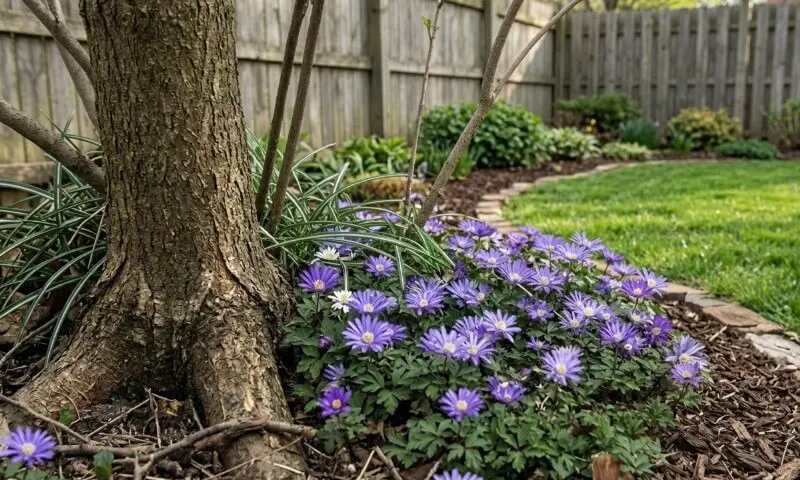
Grecian windflowers look like someone scattered handfuls of miniature daisies across the woodland floor.
Their blue, purple, pink, or white petals surround cheerful yellow centers, producing a surprisingly colorful display for plants usually standing just 4 to 6 inches tall.
Anemone blanda is particularly comfortable beneath deciduous trees where spring sunlight reaches well-drained soil.
According to North Carolina State University, Grecian windflowers can grow in partial shade, defined as roughly 2 to 6 hours of direct sunlight daily. That’s encouraging news for anyone whose garden gets a few bright hours in March before the branches overhead start filling in.
Just remember that their preference for dry summers doesn’t extend to their actively growing roots in spring.
Small underground tubers store energy during dormancy, allowing the plants to disappear when summer conditions become dry.
Given a suitable position, they can gradually multiply through seeds and form attractive colonies.
Among spring bulbs for shade under trees, Grecian windflowers are especially useful for filling smaller gaps between established roots.
One useful trick is to plant them in loose groups rather than evenly spaced rows. Woodland flowers rarely organize themselves with a ruler, and Grecian windflowers look better when allowed to appear a little spontaneous.
Just don’t confuse summer drought tolerance with an ability to grow in bone-dry spring soil.
2. Grape Hyacinths (Muscari)
View this post on Instagram
Few spring flowers pack so much color into such a small space.
Grape hyacinths produce short spikes crowded with tiny blue or violet bells, creating an almost impossibly neat arrangement.
Most familiar garden varieties reach about 6 to 8 inches tall.
Muscari performs particularly well around the outer edges of deciduous tree canopies, where spring sunshine is more generous.
Established plants can tolerate seasonal dryness, provided the soil drains reasonably well.
Many varieties multiply through offsets, which are small new bulbs developing beside the original. Some also produce plenty of seedlings.
That means a modest planting can gradually become a much larger display.
For gardeners searching for bulbs for dry shade that can multiply without much intervention, grape hyacinths are worth considering in brighter positions.
A word of caution, though. Certain grape hyacinths spread more enthusiastically than gardeners expect, so check local recommendations before introducing them near natural areas.
3. Glory-of-the-Snow (Chionodoxa/Scilla)
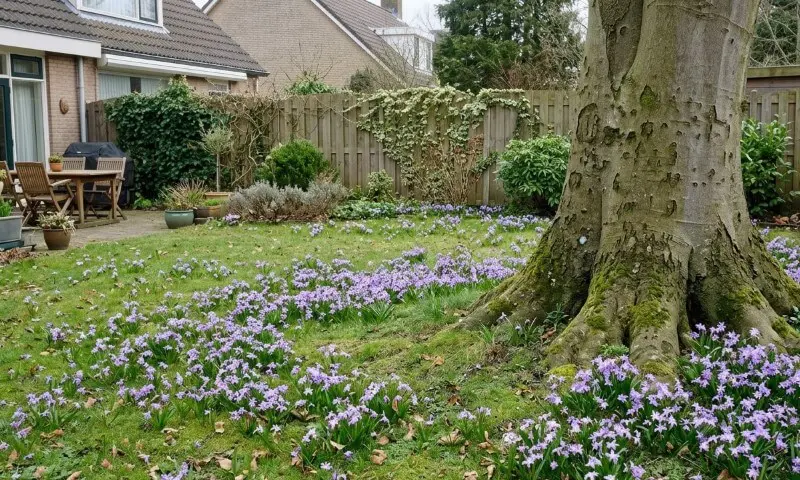
Glory-of-the-snow has a rather ambitious name for something barely taller than a coffee mug.
Fortunately, its flowers do a respectable job of living up to it.
Small, star-shaped blossoms appear in early spring, commonly in clear blue with pale centers. Pink and white selections are also available.
Depending on the botanical classification, these plants may be labeled Chionodoxa or Scilla.
Their early flowering period makes them good candidates for planting beneath deciduous trees, especially where the soil stays reasonably moist during spring before drying later.
Once established, plants can spread through seeds and bulb offsets.
Given favorable conditions, scattered flowers may eventually develop into impressive colonies.
However, naturalizing ability varies among species, and some can spread outside their intended planting area. Check regional guidance, particularly when gardening beside native woodland.
4. Siberian Squill (Scilla siberica)
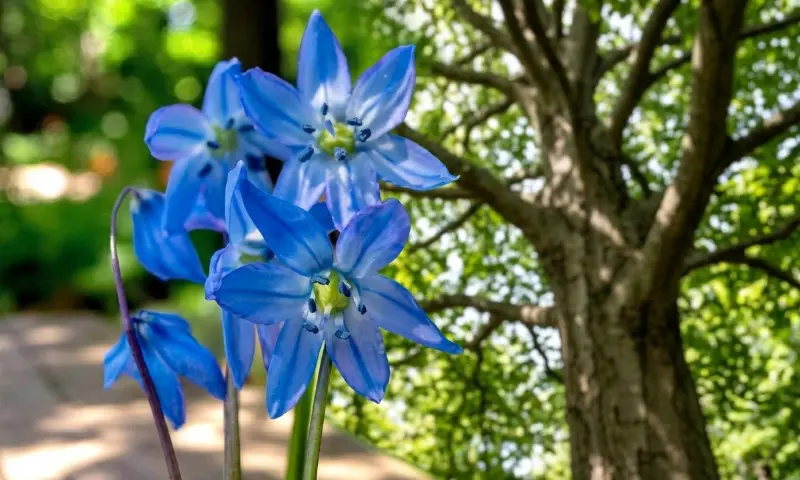
Few small spring bulbs produce quite the same electric-blue spectacle as Siberian squill.
Its nodding flowers appear on short stems, often just as the last winter snow disappears.
Under suitable conditions, scattered plants can multiply until entire patches of ground turn blue.
That sounds wonderful until you discover that Siberian squill doesn’t always respect garden boundaries.
It spreads through seeds and bulb offsets, sometimes moving into nearby woodland habitats.
Siberian squill has become invasive in parts of North America, including areas of the Upper Midwest, where spreading colonies can compete with native spring vegetation.
Its ability to colonize areas makes it a poor choice in regions where it threatens native plants.
For that reason, gardeners should check local invasive-species guidance before planting it. In affected areas, choose a less aggressive, locally appropriate species instead.
Siberian squill also needs adequate spring moisture, despite handling drier conditions after entering dormancy.
5. Daffodils (Narcissus)
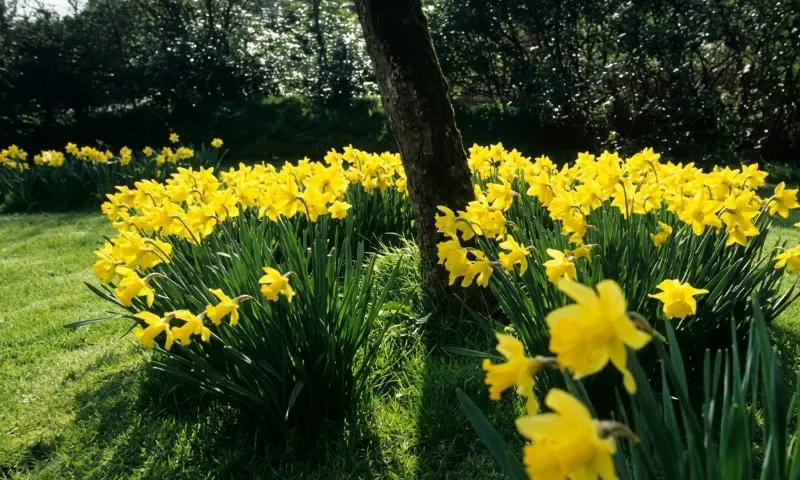
Daffodils have been turning up in spring gardens for centuries, and they’re still remarkably good at their job.
While large trumpet varieties tend to attract attention, smaller early-flowering daffodils often fit more comfortably beneath mature trees.
Cultivars such as ‘Tête-à-Tête’ produce bright yellow flowers on compact stems, usually reaching around 6 to 8 inches tall.
In its 2023 trial results, the Royal Horticultural Society recorded ‘Medway Gold’ at an average height of just 4 inches, with flowers appearing in March and April.
For a small opening between tree roots, that modest size can be considerably easier to accommodate than a full-sized daffodil nodding above everything else.
Their early growth allows them to take advantage of sunlight before the branches overhead fill with leaves.
Established daffodils also tolerate relatively dry soil during summer dormancy.
However, spring drought can interfere with their development, potentially reducing the following year’s flowers.
An additional advantage is that deer and many rodents generally avoid daffodils because their tissues contain toxic alkaloids.
Of course, that doesn’t make the bulbs safe for pets or people to eat.
When selecting spring bulbs for shade under trees, miniature daffodils are particularly sensible where the canopy allows several hours of early-season sunlight.
6. Early Crocuses (Crocus)
Crocuses sometimes appear so early that the rest of the garden hasn’t quite realized winter is ending.
Purple, yellow, and white flowers push through fallen leaves, occasionally opening beside patches of melting snow.
Early species such as Crocus tommasinianus and Crocus chrysanthus are particularly useful beneath leafless deciduous trees.
Unlike daffodils, crocuses grow through corms, which are swollen underground stems that store nutrients.
Their leaves collect energy during spring before disappearing as temperatures rise.
Well-drained soil and plenty of early sunlight help produce reliable flowering.
For difficult planting sites, try placing crocuses near the outer canopy rather than immediately beside the trunk.
Their small size also makes them useful for planting in narrow spaces between larger tree roots.
Just remember that squirrels and other rodents sometimes dig up crocus corms, especially shortly after planting.
How to Plant Spring Bulbs Around Tree Roots
Picture a mature maple with thick surface roots, compacted soil, and a few patches where fallen leaves collect every autumn.
Trying to turn the entire area into a conventional flower bed would be an exhausting mistake.
Established trees have extensive root systems, including fine feeder roots that absorb water and nutrients close to the soil surface.
Damaging those roots or burying them beneath substantial amounts of new soil can harm the tree.
A better approach involves working with what’s already there.
Plant most spring-flowering bulbs in fall, locating natural gaps between roots with a narrow trowel.
If you encounter a substantial root, move a few inches rather than cutting through it.
Follow each species’ recommended planting depth.
Planting depth deserves a little more thought than simply digging until the trowel looks sufficiently muddy.
University of Minnesota recommends a general depth of two to three times the bulb’s diameter, with adjustments for soil conditions. Sandy soil may call for an extra inch or two, while heavy clay often requires shallower planting.
Species-specific instructions still come first, especially when dealing with tiny corms and tubers rather than conventional bulbs.
A little finished compost or leaf mold can improve surface soil conditions where appropriate. Avoid heavy excavation or burying the tree’s root flare.
There’s a good ecological reason to leave some leaves beneath your trees, since bumble bee queens and other beneficial creatures may be sheltering among them. Just avoid burying tiny emerging bulbs beneath excessively thick, matted layers.
Water after planting, particularly when autumn rainfall is scarce.
For a natural woodland appearance, plant bulbs in irregular clusters rather than straight lines.
One practical experiment is to test three planting locations around the same tree.
Place small groups near the outer canopy, midway beneath the branches, and in a more shaded position. Keep the species and planting conditions as similar as possible.
Compare flowering the following spring.
A Little Color Beneath the Canopy
A mature tree doesn’t have to condemn the ground beneath it to permanent emptiness.
Grecian windflowers, grape hyacinths, glory-of-the-snow, miniature daffodils, and early crocuses can all brighten difficult places when their seasonal needs are met.
Choosing suitable spring bulbs for shade under trees means paying attention to seasonal sunlight, spring moisture, and how thoroughly tree roots dry the soil.
Some plants prefer the brighter canopy edges. Others tolerate partial shade and fairly dry summers.
Finding dependable bulbs for dry shade is ultimately less about fighting the tree and more about recognizing the opportunities its changing canopy provides.
After all, spring bulbs have a clever way of dealing with competition.
They wake up early, enjoy their moment in the sunshine, and retreat underground just as the trees are getting comfortable.