Every autumn, gardeners perform a familiar little ceremony. Leaves tumble onto lawns, paths, and flower beds, rakes come out of storage, and enormous bags of perfectly useful organic material disappear into the garden waste collection.
Meanwhile, beneath the trees, another problem is developing.
Soil is dry, roots are competing for every available drop of water, and shade-loving plants are looking distinctly unimpressed with their living arrangements.
Oddly enough, one problem can help solve the other.
Leaf mold for dry shade is one of the simplest ways to improve moisture retention and soil structure without spending much money.
All it requires is fallen leaves, a suitable place to store them, some moisture, and patience.
Woodlands have been managing this arrangement for millions of years. Gardeners simply need to borrow the idea.
How to Make Leaf Mold from Fallen Leaves
Making leaf mold requires remarkably little equipment. Gardening has produced plenty of complicated products over the centuries, but decomposing leaves have never needed much encouragement.
Choose and Collect Your Leaves
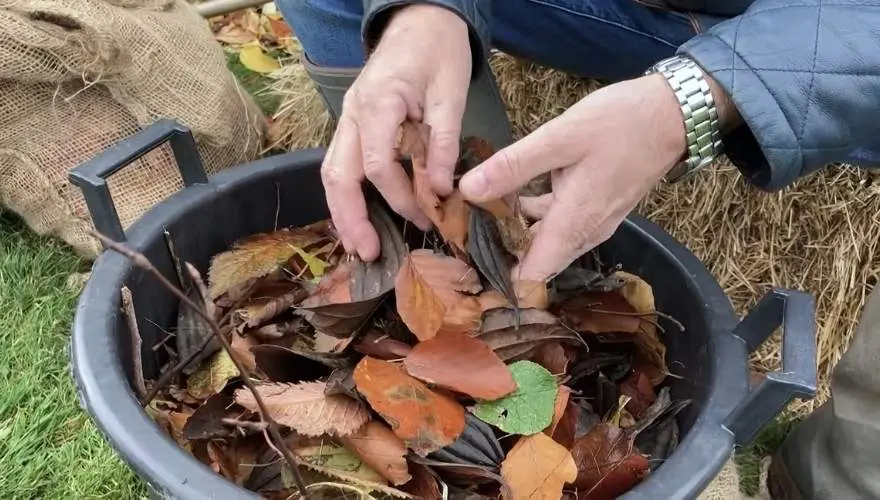
Autumn offers the best opportunity to gather leaves because deciduous trees are conveniently delivering the ingredients directly to the ground.
Oak, beech, birch, hornbeam, and maple leaves are all suitable choices.
Oak and beech leaves produce particularly useful leaf mold, although decomposition rates vary considerably according to thickness, moisture, and temperature.
Thicker leaves, including horse chestnut and some sycamore species, generally take longer to break down.
One useful trick is to shred tougher leaves before storing them.
Running a lawn mower over a shallow layer of fallen leaves breaks them into smaller pieces, exposing more surface area to the fungi responsible for decomposition.
Smaller pieces also settle more evenly, allowing moisture to penetrate the material more readily.
Collect leaves in reasonably clean areas, preferably away from heavily trafficked roads, chemical contamination, and obvious signs of disease.
Avoid adding large quantities of grass clippings if the goal is traditional leaf mold. Small amounts collected accidentally with a mower are not a problem, but substantial quantities change the decomposition process.
Choose Your Method
Available space usually determines the best method. Fortunately, a garden doesn’t need a dedicated composting area or elaborate wooden bins.
Three practical options work well:
| Method | How it works | Suitable situation |
| Plastic bags | Fill with damp leaves, add ventilation holes, and loosely close | Small gardens |
| Wire-mesh cage | Contain leaves inside a ventilated enclosure | Large quantities of leaves |
| Open leaf heap | Gather leaves in a sheltered corner | Gardens with spare space |
Plastic bags are particularly convenient for gardeners working with limited space.
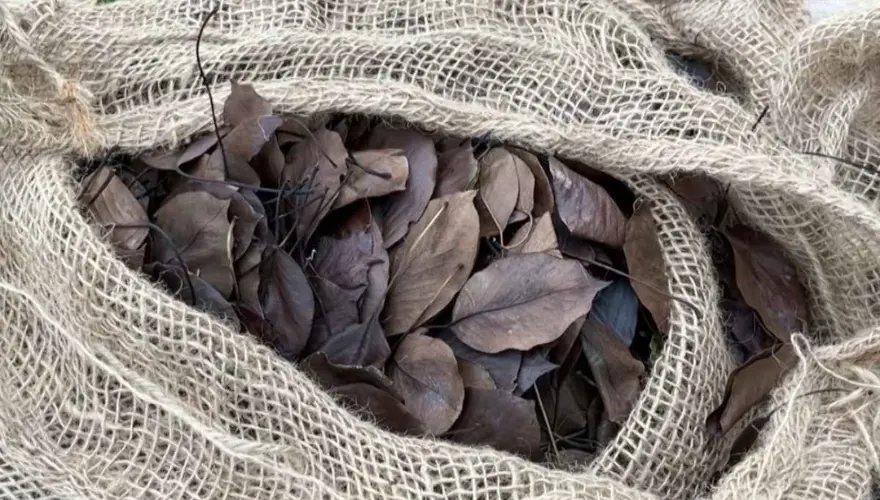
Fill sturdy bags with damp leaves, pierce several small holes for ventilation, and leave them somewhere sheltered. Bags should contain moisture without becoming waterlogged.
A wire-mesh cage offers better natural ventilation and makes collecting large amounts easier. Four wooden stakes and some chicken wire are usually sufficient.
For an open heap, choose a sheltered corner where wind won’t immediately undo your careful gathering.
Whichever method you choose, moisture is essential. Fungi need damp conditions to break down organic material.
Aim for leaves that feel like a wrung-out sponge, not a soaking wet pile.
Give Them Time
Patience is arguably the most demanding ingredient.
Leaf mold generally takes around 12 to 24 months to develop, although shredded leaves can produce usable material sooner under favorable conditions.
Whole, leathery leaves may need two years or longer.
Shredding can shorten that timetable considerably. Fine-textured leaf mold may develop in as little as 6 to 12 months when shredded leaves have suitable moisture and ventilation. Whole leaves commonly need closer to two years.
A few minutes with a lawn mower in autumn can therefore save several months of waiting, which is a fairly respectable return on a job most gardeners were planning to do anyway.
Cool temperatures slow decomposition, while moisture shortages can bring fungal activity nearly to a halt.
Check occasionally, especially during extended dry periods. If leaves feel completely dry, sprinkle them with water.
A compacted, saturated pile may also need loosening to restore air circulation.
After roughly one year, leaves may have softened considerably while retaining recognizable shapes. Such material is useful as coarse mulch.
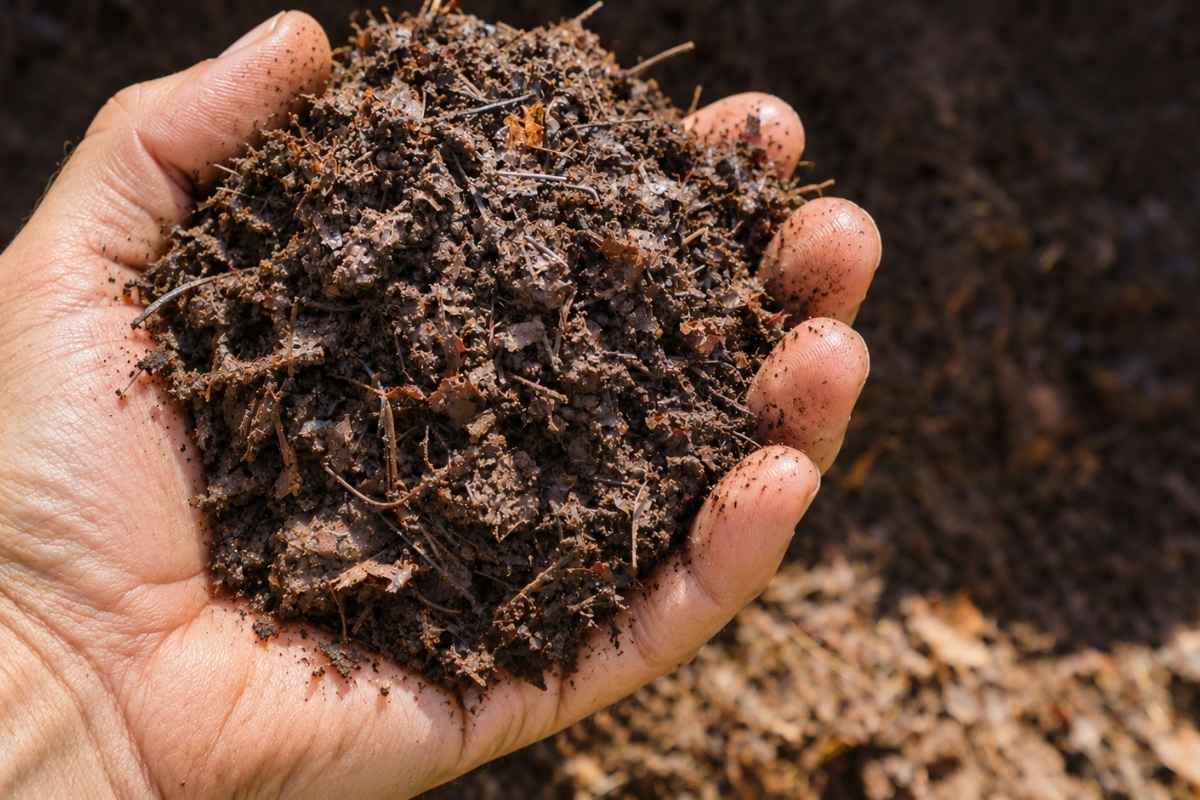
Fully matured leaf mold looks quite different. Individual leaves are difficult to identify, and the material has a dark, crumbly texture with a pleasant earthy smell.
An interesting practical detail is that leaf piles shrink dramatically during decomposition.
A cage filled to the top in November may look surprisingly empty the following autumn. Nothing mysterious has happened. Much of the original material has broken down, and the leaves have settled into a much denser mass.
For a reliable annual supply, prepare a new batch each autumn while the previous collection continues decomposing.
See how fallen leaves can be transformed into valuable leaf mold for improving garden soil and creating natural mulch.
How to Use Leaf Mold in Dry Shade
Producing leaf mold is only half the process. Applying it correctly makes the difference between improving a difficult garden bed and simply moving decomposed leaves around.
Mulch Around Established Plants
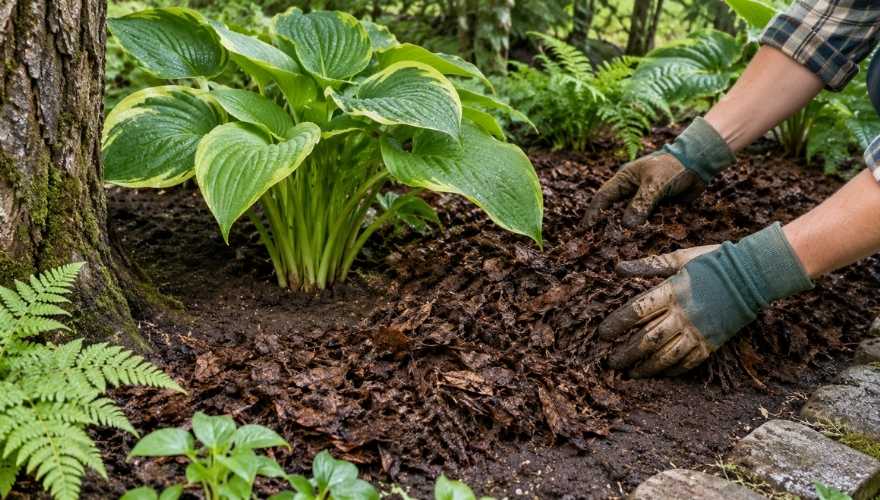
One of the most effective uses is spreading leaf mold across the soil surface.
Apply approximately 2 to 3 inches (5 to 7.5 cm) around established shade plants, preferably after rainfall or thorough watering.
More mulch isn’t necessarily better, either. In the same experiment, increasing the layer from 2 to 4 inches maintained soil moisture about 10% higher during much of the testing period.
Piling on another 2 inches produced no measurable additional benefit. Gardeners can take some comfort in knowing that even mulch has a point at which extra effort stops paying off.
Moist soil matters because mulch helps conserve water already present in the ground. Covering completely dry soil does little to correct an existing moisture shortage.
A suitable layer reduces evaporation, moderates temperature fluctuations, and gradually contributes organic material as it decomposes.
Keep mulch slightly away from plant crowns and tree trunks. Constant moisture against these areas can encourage decay and other problems.
Consider a typical shady border measuring 10 feet by 5 feet.
Covering that 50-square-foot area with a 2-inch layer requires approximately 8.3 cubic feet of finished leaf mold, or about 0.31 cubic yards.
Increasing the layer to 3 inches raises the requirement to approximately 12.5 cubic feet, or 0.46 cubic yards.
Such calculations are useful because a modest pile of decomposed leaves rarely covers as much ground as gardeners expect.
For limited supplies, prioritize the driest sections or areas surrounding newly established plants rather than spreading a barely visible layer across an entire bed.
Improve Dry, Poor Soil
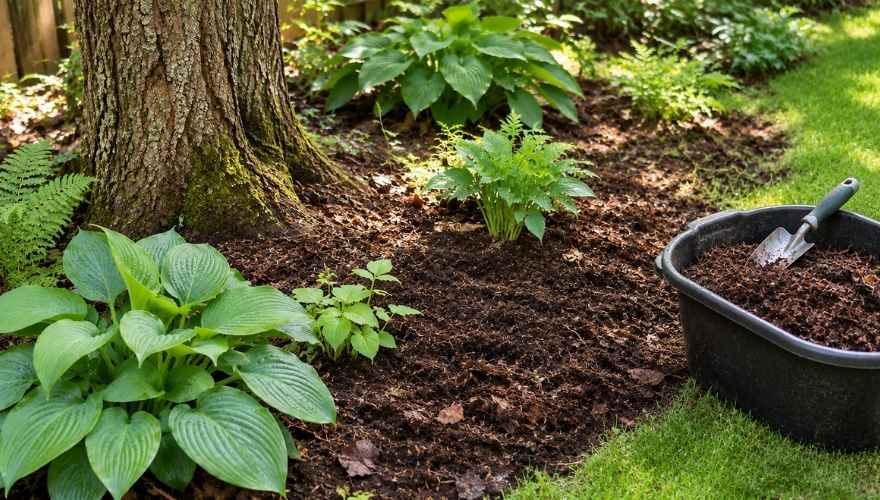
Dry shade often combines two frustrating conditions: inadequate moisture and soil that struggles to retain the water it receives.
Finished leaf mold can help improve both sandy and compacted soils.
Mulching is particularly useful in places where every watering needs to count. University of New Hampshire notes that organic mulch can reduce evaporation at the soil surface by as much as 70% compared with uncovered ground.
Before planting, gently work well-decomposed leaf mold into the upper soil layer where roots will develop.
Organic matter improves aggregation, meaning individual soil particles gradually form more stable groups with spaces for water and air.
Sandy soils can consequently retain moisture more effectively, while heavier soils may become easier for roots to penetrate.
Established trees require a different approach.
Digging around mature roots can damage the very plants creating the shade. Many important absorbing roots grow close to the soil surface, extending well outside the visible canopy.
Surface application is generally the safer choice beneath established trees.
For example, consider a dry border beneath a mature maple. Small perennials struggle to establish, yet digging several inches into the ground immediately exposes a network of fine tree roots.
Instead of excavating the entire bed, remove weeds carefully, water the soil, and apply finished leaf mold around existing plants.
Allow soil organisms and natural weathering to gradually move organic material into the upper soil. Results will develop gradually, but root disturbance is minimized.
One frequently overlooked issue is rainfall interception.
Under dense tree canopies, light showers may barely wet the ground. Check soil moisture several inches below the surface rather than assuming rain has reached the roots.
Leaf mold can reduce subsequent moisture losses, but occasional thorough watering may still be necessary.
Help Shade Plants Establish
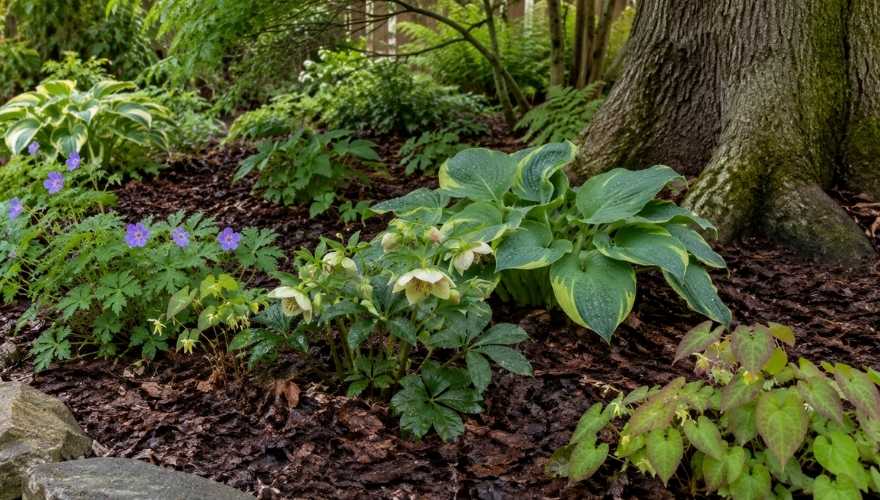
Not every shade-loving plant tolerates dry soil.
Hostas, for example, generally appreciate consistent moisture, while other species are considerably better equipped for competition beneath trees.
Leaf mold makes a useful growing environment for several established dry-shade favorites.
Epimediums are excellent candidates for dry shade once established.
Their spreading foliage helps cover difficult ground, and delicate spring flowers provide welcome color beneath trees.
Hellebores are useful for partial shade and humus-containing soil. Established plants can tolerate some dryness, although severe summer drought may still cause stress.
Hardy geraniums have certain species, particularly Geranium macrorrhizum, that handle dry shade relatively well and can gradually form attractive ground cover.
Plant selection still depends on soil type, climate, and the intensity of root competition.
Newly planted perennials need regular attention during their first growing season, even when their mature counterparts are drought-tolerant.
Water thoroughly during establishment and monitor soil moisture during prolonged dry weather.
Leaf mold improves the conditions available to roots, but adequate watering during the initial growing period is still essential.
Another consideration is the source of your material.
Leaf mold made through a cool fungal process does not reliably destroy weed seeds or plant pathogens. Avoid spreading material containing troublesome weeds or obviously diseased debris around valuable plants.
Let the Leaves Do the Work
Gardening has a peculiar habit of turning useful natural processes into problems requiring expensive solutions.
Autumn leaves get collected and discarded, while gardeners purchase soil conditioners to help the ground retain moisture.
Leaf mold offers a simpler arrangement.
A few bags of leaves, a sheltered corner, and some patience can produce an excellent material for improving dry, shaded beds.
Progress may be slow, particularly beneath thirsty mature trees, but healthier soil develops gradually through repeated applications and consistent moisture management.
Next autumn, before clearing every last leaf out of the garden, consider keeping a few bags.
After all, woodland soil has benefited through this process for millions of years, without a single trip to the garden center.